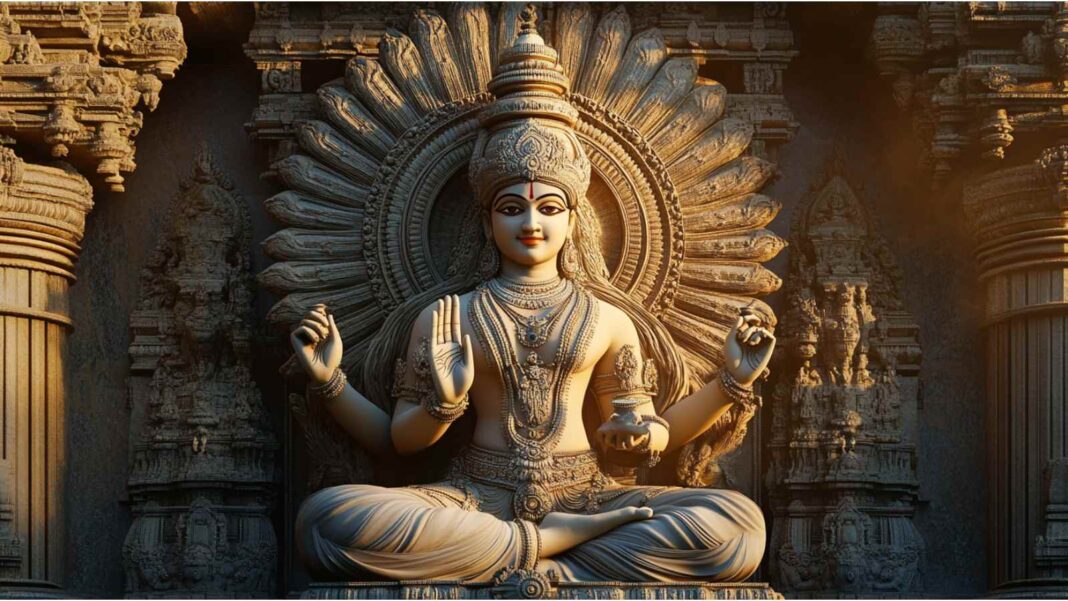

In the vast and intricate tapestry of Hinduism, few deities epitomize divine balance and cosmic order as clearly as Lord Vishnu. Revered as the Preserver, Vishnu’s primary role is to uphold dharma—the eternal law, cosmic order, and justice that supports the very fabric of existence. This blog examines Vishnu’s timeless role through the lens of Hindu scriptures, mythology, philosophy, and cultural traditions.
Read More About sacred texts
Vishnu’s presence is not just a symbol of preservation; he is an active force intervening in cosmic affairs, ensuring that righteousness prevails in times of chaos. As his devotees look to him for guidance, Vishnu’s legacy provides a window into the dynamic interplay of order and chaos, life and death, and the eternal cyclic nature of the universe.
The Cosmic Role of Vishnu

The Concept of Dharma
In Hindu philosophy, dharma signifies the moral and ethical principles that govern the universe. It is both personal duty and cosmic law. Dharmic order is the foundation of social and cosmic harmony, and its preservation is central to maintaining balance in the universe.
- Cosmic Order (Rta): Rooted in ancient Vedic concepts, rta refers to the natural order of the cosmos. Vishnu’s continuous intervention serves to realign the universe with this primordial order whenever disturbances arise.
- Ethical and Moral Dimensions: Beyond the metaphysical, dharma encompasses the human pursuit of virtue, righteousness, and balance in personal conduct. Vishnu’s narratives are replete with lessons on ethical dilemmas and moral choices, providing a guide to righteous living.
Vishnu’s Role as the Preserver
Lord Vishnu is celebrated for his benevolent role in Hindu cosmology. While Brahma initiates creation and Shiva is associated with destruction and regeneration, Vishnu is the custodian who preserves life and cosmic balance by:
- Restoring Equilibrium: Whenever the balance of the universe is threatened by adharma (unrighteousness), Vishnu incarnates in various forms (avatars) to reestablish order.
- Divine Intervention: His interventions are often dramatic, symbolizing the direct involvement of the divine in worldly affairs. Through events narrated in the Mahabharata, Ramayana, and numerous Puranas, Vishnu is depicted as ensuring that righteousness and justice prevail.
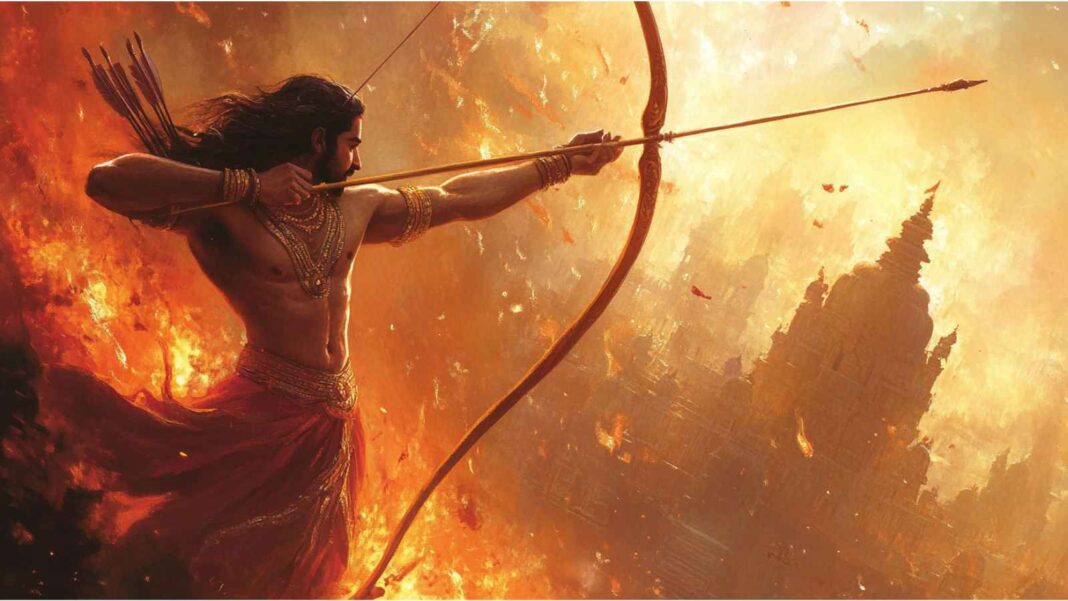
- Manifest Avatars: The concept of avatar—divine incarnation—is integral to understanding Vishnu’s preservation role. His various avatars, most famously Krishna and Rama, manifest to confront and overcome the pervasive forces of chaos and unrighteousness.
“Whenever there is a decline in righteousness and an increase in unrighteousness, at that time I manifest Myself on Earth.”
– Bhagavad Gita
Detailed Exploration of Vishnu’s Avatars

Krishna: The Divine Statesman
One of Vishnu’s most celebrated avatars, Krishna, appears as an enigmatic statesman, divine lover, and skilled warrior. His life teaches profound lessons on the nature of duty, love, and the path to liberation:
- The Bhagavad Gita: As a charioteer and guide to the warrior Arjuna, Krishna expounds the teachings of the Gita. This scripture remains one of the most influential texts in Hindu philosophy, offering insights into ethical dilemmas, the nature of self, and the imperatives of duty.
- Diplomacy and Love: Krishna’s early life is rich with stories of divine play (lila) that merge the spiritual with the mundane. His exploits underscore his role as a compassionate guardian who balances the sometimes harsh realities of mortal life with divine love and wisdom.
“I am time, the great destroyer of the world.”
– Krishna, Bhagavad Gita
Rama: The Ideal King and Embodiment of Virtue
Another principal avatar of Vishnu, Rama epitomizes the virtues of honor, sacrifice, and duty. His story, as told in the epic Ramayana, has inspired countless devotees:
- The Ideal King: Rama’s reign is viewed as a period of perfect governance and righteousness, setting the standard for ideal leadership. His actions reflect an unwavering commitment to fairness, loyalty, and the preservation of social order.
- Trials and Triumphs: The epic narrative of Rama illustrates the struggles against overwhelming adversities, emphasizing that true power lies not in dominion but in compassion and adherence to dharma.
- Cultural Legacy: Festivals and religious practices centered on Rama’s life, including the festival of Diwali, celebrate his return to his kingdom after a period of exile, symbolizing the victory of light over darkness.
“For the sake of the world, I have come, full of energy, to dispel the darkness of ignorance and to uphold righteousness.”
– Traditional verse inspired by the Ramayana
Vishnu’s Cosmic Function and the Cycle of Creation

The Cycle of Creation, Preservation, and Destruction
Hindu cosmology is profoundly cyclical, characterized by the interdependent phases of creation, preservation, and destruction. Vishnu’s role is defined within this cycle as the preserver who maintains balance during the phases between creation and destruction:
- Brahma and Shiva: While Brahma creates and Shiva destroys, Vishnu’s function is to keep the universe in a stable state—a guardian against the extremes of chaos and stagnation.
- Cyclic Time: In Hindu thought, time is not linear but cyclical. Each cycle, known as a Kalpa, witnesses the periodic manifestation of the divine in various forms, with Vishnu’s avatars being central to reintroducing dharma whenever adharma becomes too overwhelming.
Cosmic Order and Justice in Hindu Thought
The preservation of cosmic order is not merely a mythological concept; it carries deep philosophical, social, and moral implications:
- The Nature of Justice: In the framework of Hindu ethics, justice is intrinsically linked to dharma. Vishnu’s actions—especially his incarnations—serve to reinforce that justice is a divine mandate and that every individual has a role to play in sustaining social harmony.
- Modern Interpretations: Contemporary scholars often draw parallels between ancient dharma and modern ethical frameworks. Vishnu’s life stories serve as allegories, inspiring both personal and societal reform. They suggest that the struggle for justice is timeless and must be continually renewed.
The Interplay of Free Will and Destiny
Hindu philosophy stresses that while the cosmic order is maintained by divine intervention, human beings play an active role in this ongoing drama:
- Karma and Dharma: The principles of karma (action) and dharma are intricately connected. An individual’s actions contribute to the broader tapestry of cosmic order. Vishnu’s avatars appear precisely because the balance tips too far in one direction.
- Spiritual Guidance: For devotees, the stories of Vishnu and his avatars offer a blueprint for moral living and remind us that human free will, when aligned with cosmic law, can have far-reaching consequences.
Sacred Texts and Mythological Narratives
Vedas, Upanishads, and the Bhagavad Gita
The sacred texts of Hinduism form the backbone of its philosophical and spiritual teachings. References to Vishnu’s role can be found throughout these texts:
- Vedas: Among the Rig Veda hymns, early hints of Vishnu’s cosmic role appear as a deity who upholds the order of the universe.
- Upanishads: These texts offer a more metaphysical view of Vishnu, linking his preserving function to the concept of the eternal Self (Atman) and the universal spirit (Brahman).
- Bhagavad Gita: This dialogue between Krishna and Arjuna is not only a spiritual guide but also a treatise on duty and righteousness. Here, Vishnu’s message is clear: the pursuit of one’s duty is paramount for sustaining the cosmic order.
“Perform your obligatory duty, because action is indeed better than inaction.”
– Bhagavad Gita
Puranic Stories and Their Significance
The Puranas, such as the Vishnu Purana and the Bhagavata Purana, provide rich narratives that illustrate Vishnu’s interventions in the world:
- Narrative Richness: These texts weave stories of divine play, battles between good and evil, and miraculous interventions that underscore the dynamic nature of dharma.
- Moral and Social Lessons: Each story in the Puranas carries a lesson. From vanquishing demons to providing guidance to kings, Vishnu’s tales are a repository of moral and spiritual wisdom that continues to inspire devotees and scholars alike.
The Symbolism of Vishnu’s Iconography
Attributes and Iconography
Vishnu’s divine attributes are deeply symbolic, reflecting his role as the preserver of cosmic order:
- The Conch (Shankha): Symbolizes the primordial sound and the call to awaken to one’s duty. Its echo represents the call to righteousness.
- The Discus (Sudarshana Chakra): This spinning weapon represents the divine mind—swift, precise, and capable of cutting through ignorance and evil.
- The Mace (Gada): Symbolizes mental and physical strength. It embodies the power of truth and justice.
- Lotus Flower: An emblem of purity and spiritual awakening, the lotus signifies the divine origin and the blossoming of life when nurtured by dharma.
The Presence in Temples and Rituals
Across India and in Hindu communities around the world, temples dedicated to Vishnu are centers of spiritual activity. These temples not only offer architectural splendor but also serve as living classrooms for the teachings of dharma:
- Architectural Symbolism: Many temples feature intricate carvings and iconography that illustrate the life and teachings of Vishnu and his avatars.
- Rituals and Festivals: Major festivals such as Janmashtami (celebrating Krishna’s birth) and Rama Navami (celebrating Rama’s birth) are vibrant occasions when communities come together to celebrate the divine order and the victory of dharma over adharma.
Cultural and Contemporary Significance
Vishnu’s Influence on Art and Literature
Vishnu’s enduring appeal transcends religious texts to influence a wide range of cultural expressions:
- Classical Music and Dance: Many traditional art forms, like Bharatanatyam and Odissi dance, incorporate themes from Vishnu’s lore, thus perpetuating ancient myths through graceful movement and music.
- Literary Traditions: Poets, dramatists, and authors have long drawn inspiration from the narratives of Vishnu’s avatars. His stories serve as metaphors for the human condition and the eternal struggle between light and darkness.
Modern Relevance: Ethics and Governance
In a rapidly changing world, the principles embedded in Vishnu’s narratives continue to offer guidance:
- Ethical Governance: Vishnu’s depiction as the divine arbiter of justice and moral order provides a timeless model for leadership. Modern political theorists sometimes reference these ideals when discussing ethical governance and the responsibilities of leadership.
- Social Justice: The idea that the divine intervenes to restore balance reinforces the notion that social justice is a continuous effort. It encourages communities to work towards systems that promote fairness, inclusivity, and the welfare of all.
Personal and Spiritual Growth
For many individuals, Vishnu’s teachings are not simply abstract ideas—they are a lived reality:
- Daily Practices: Devotees incorporate rituals such as meditation, recitation of the Vishnu Sahasranama (the thousand names of Vishnu), and prayers into their daily lives to seek the divine’s blessings and maintain spiritual balance.
- Community Engagement: Local communities often engage in service projects and ethical living inspired by Vishnu’s emphasis on preserving cosmic order. This is a reminder that everyone, by living a life aligned with dharma, contributes to the overall balance of the universe.